
By clicking Get My Free Quote, I give Tina Gregory Agency (Tina Gregory Insurance Agency LLC) and its licensed agents, and, for quotes from insurance companies other than Farmers, Kraft Lake Insurance Agency, my prior express written consent, by electronic signature, to contact me with calls and text messages — including marketing calls and texts made using automated technology or an artificial or prerecorded voice — and by email, at the number and email I provided, about my insurance quote and related insurance products and services, even if my number is on a Do Not Call list. My information is never sold or shared with other agencies for their own marketing. Consent is not a condition of purchase; I can call (573) 358-4513 instead. Message frequency varies. Message and data rates may apply. Reply STOP to opt out, HELP for help. I agree to the Privacy Policy and Terms of Use, including the arbitration clause and E-SIGN consent.
Maybe a spring hailstorm just rolled through and you’re wondering whether to call about the roof. Maybe your renewal came with a new wind and hail deductible you don’t remember choosing. Or maybe you watched the Meramec come up last time and realized you have no idea whether your policy would pay for water in the house.
Around Sullivan, a home can face hail, straight-line wind, a tornado warning, a river or creek out of its banks and karst ground that opens into sinkholes, sometimes in the same year. A standard home policy treats each of those differently. Some are covered with a deductible, some need their own policy and some are excluded unless you add them. This playbook is for any Missouri homeowner in storm, flood and sinkhole country. It walks through each peril, what it costs you at claim time and what we’d ask about before the next storm.
How does a standard Missouri home policy treat each storm and ground risk?
The short answer: Hail, wind and tornado damage are usually covered subject to your deductible, while flood, earthquake and sinkhole damage usually aren’t and each needs separate coverage.
A standard homeowners policy covers sudden, accidental damage from a list of causes, and it excludes others by name. Weather from above, like hail and wind, is generally in. Water from outside and ground that moves underneath the house are generally out. Here’s the quick map, peril by peril. Your own policy and its endorsements decide what’s actually covered, so treat this as the questions to ask, not the answer for your house.
| Peril | Standard home policy | How to fill the gap |
|---|---|---|
| Hail | Usually coveredSubject to your deductible, which may be a percentage. | Know your deductible in dollars and how your roof is paid (replacement cost or actual cash value). |
| Wind and tornado | Usually coveredWind damage, including tornadoes, subject to your wind/hail deductible. | Check your dwelling limit and loss-of-use coverage, not just the deductible. |
| Flood (rising water) | ExcludedRising water from rivers, creeks and runoff isn’t covered. | A separate flood policy through the NFIP, or private flood where available. |
| Sewer or sump backup | Usually excludedUnless you add it. | A water backup endorsement on your home policy. |
| Sinkhole | Usually excludedFalls under the earth-movement exclusion. | Sinkhole coverage by endorsement where an insurer offers it, or the FAIR Plan’s sinkhole policy. |
| Earthquake | ExcludedDCI: “Your homeowners policy does not cover damage from an earthquake.” | An earthquake endorsement or a separate earthquake policy. |
| No company will write the home | No policyAfter a nonrenewal or a hard-to-place home. | Shop the regular market first; the Missouri FAIR Plan is the last resort. |
Two things on that list cause most of the surprises we see: a percentage deductible nobody turned into dollars, and the assumption that “water damage” includes a flood. We’ll take each peril in turn.
Are hail and wind damage covered, and what will you actually pay?
The short answer: Usually yes, but your share depends on your deductible and how the policy pays for your roof, and a percentage deductible can run to several thousand dollars.
Hail and windstorm are covered causes of loss on a typical Missouri homeowners policy. DCI’s roof guide puts it simply: wear and tear on a roof isn’t covered, but “a windstorm that rips up a section of your roof is.” The questions that decide your out-of-pocket cost come after that.
Percentage deductibles. DCI’s deductible guide notes that “some insurance companies sell homeowners insurance policies with percentage deductibles for wind and hail damage,” paired with a flat dollar deductible for theft and other losses. The percentage is based on the home’s insured value. DCI’s example: a house insured for $100,000 with a 2% deductible has $2,000 subtracted from any claim the insurer pays.
- With a $1,000 flat deductible, you pay the first $1,000.
- With a 1% wind/hail deductible, you pay the first $2,500.
- With a 2% wind/hail deductible, you pay the first $5,000.
How the roof is paid. DCI explains the three common ways. Actual cash value pays the depreciated cost, so an older roof pays less. Replacement cost pays to repair or replace without deducting depreciation. Functional replacement cost pays to replace with a functional equivalent. Some policies also have roof payment schedules or terms for cosmetic damage, and DCI’s March 2021 severe-weather release advises homeowners to “review your roof coverage” because “insurance policies and levels of coverage vary greatly.”
Here’s what shapes your share of a storm claim:
Flat or percentage
A percentage wind/hail deductible grows with your dwelling limit. Turn it into dollars.
Replacement cost or ACV
Actual cash value subtracts depreciation, which can be large on an older roof.
Roof age and material
Some policies pay older roofs on a schedule. Ask how yours works before you need it.
Dwelling limit
It should match what it would cost to rebuild, not what the house would sell for.
Other structures
On acreage, a barn, shop or pole building can outgrow the default other-structures limit.
What you added
Water backup, scheduled items and other add-ons change what a storm claim can include.
One more storm note: hail on your car isn’t a home claim. It falls under the comprehensive coverage on your auto policy, which our Missouri car insurance guide explains.
What does a tornado claim look like on a Missouri home policy?
The short answer: Tornado damage is wind damage, so it’s usually covered under your wind/hail deductible, and your dwelling, other-structures and loss-of-use limits decide how far the claim goes.
Tornadoes are part of life in Missouri. The National Weather Service office in St. Louis counted an average of 34 tornadoes a year in Missouri from 1950 through 2019, in its Missouri Severe Weather Statistics. Most never touch a house. The ones that do can damage a whole neighborhood at once.
That’s what made 2025 hard. DCI reported on July 31, 2025 that insurers had received more than 173,000 claims on home, renters, condo and auto policies from that year’s catastrophic weather events, and had paid almost $1.6 billion as of July 16, with total payments projected to reach about $1.8 billion. The May 16 tornado in St. Louis alone produced nearly 9,000 claims.
When a tornado or straight-line wind does real damage, three coverages carry the claim:
- Dwelling. If the house has to be rebuilt, your dwelling limit is the ceiling. After a widespread storm, labor and materials can cost more than usual, which is why we set dwelling limits at rebuild cost, not market value.
- Other structures. Detached garages, fences, sheds and barns usually have their own limit, often a percentage of the dwelling limit.
- Loss of use. If you can’t live in the house, this pays extra living costs like rent or a hotel, up to its limit. After a big storm, when roofers are booked and rentals fill up, it can matter more than people expect.
Why doesn’t home insurance cover flooding, and how do you buy flood coverage?
The short answer: Standard home and renters policies exclude flood, so you need a separate flood policy, usually through the NFIP, and a new one generally takes 30 days to start.
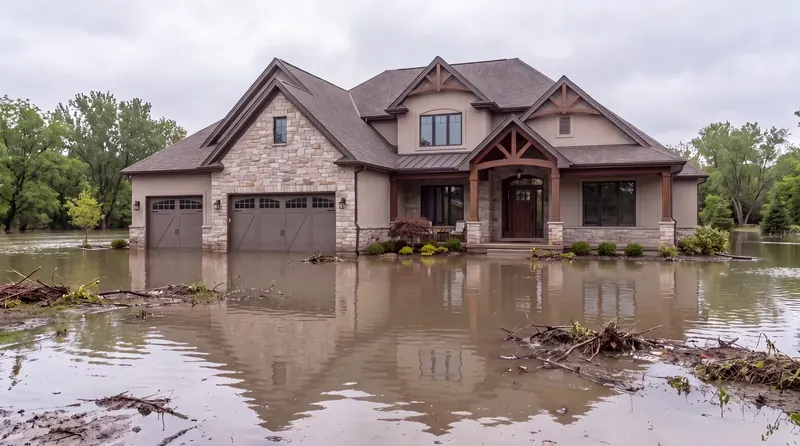
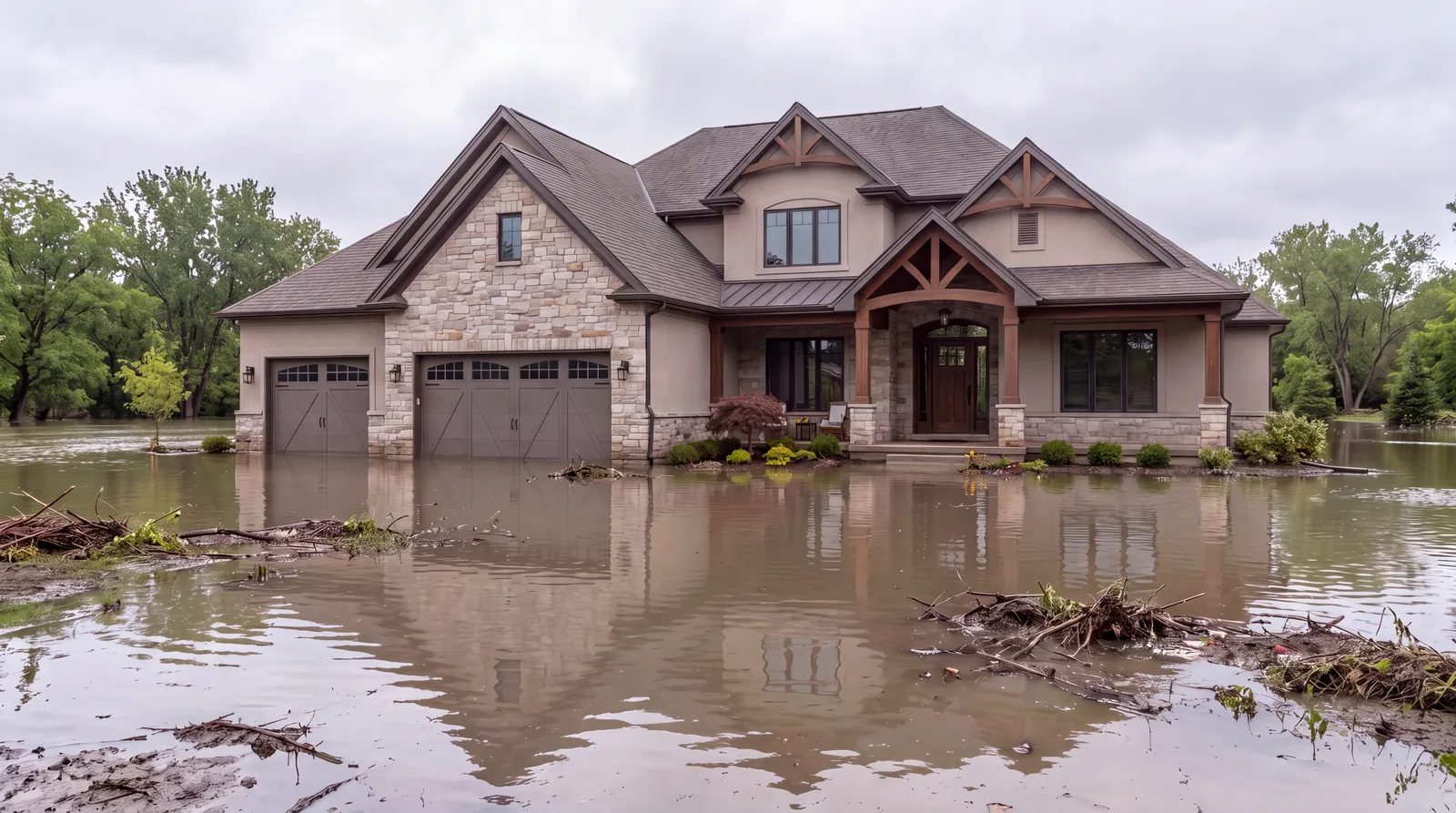
DCI said it plainly in that March 2021 release: “A standard homeowners policy does not cover flood damage.” Rising water from the Meramec, the Bourbeuse, a creek or runoff that covers the yard is a flood, and it needs a flood policy. Most are written through FEMA’s National Flood Insurance Program. The NFIP’s limits are $250,000 for the building and $100,000 for contents, according to FloodSmart, and private flood coverage may also be available.
This isn’t a theoretical risk here. In December 2015, the National Weather Service in St. Louis recorded record crests from Union to Arnold, “in most cases” at least a foot above the old record:
| River gauge | December 2015 crest | Previous record |
|---|---|---|
| Bourbeuse River at Union | 34.31 ft (Dec. 29) | 33.8 ft (Dec. 1982) |
| Meramec River at Pacific | 33.42 ft (Dec. 30) | 32.71 ft (Dec. 1982) |
| Meramec River near Eureka | 46.06 ft (Dec. 30) | 42.89 ft (Dec. 1982) |
| Meramec River at Valley Park | 44.11 ft (Dec. 31) | 39.73 ft (Dec. 1982) |
Less than a year and a half later, it happened again. On the night of April 30, 2017, NWS St. Louis forecast record flooding on the Meramec near Sullivan. The U.S. Geological Survey reported record or near-record crests in the Bourbeuse and Meramec basins that week, and the NWS summary of that spring event notes that at least four river gauges set new record crests.
Sullivan and the NFIP. NFIP coverage is available where a community participates in the program, and FEMA’s Community Status Book lists the City of Sullivan (Crawford and Franklin counties) as a participating community, in the program’s regular phase since 1981. Whether your address is in a mapped high-risk zone is a separate question you can check on FEMA’s Flood Map Service Center. Lenders generally require flood insurance in high-risk zones, but water doesn’t always stop at a zone line.
By clicking Get My Free Quote, I give Tina Gregory Agency (Tina Gregory Insurance Agency LLC) and its licensed agents, and, for quotes from insurance companies other than Farmers, Kraft Lake Insurance Agency, my prior express written consent, by electronic signature, to contact me with calls and text messages — including marketing calls and texts made using automated technology or an artificial or prerecorded voice — and by email, at the number and email I provided, about my insurance quote and related insurance products and services, even if my number is on a Do Not Call list. My information is never sold or shared with other agencies for their own marketing. Consent is not a condition of purchase; I can call (573) 358-4513 instead. Message frequency varies. Message and data rates may apply. Reply STOP to opt out, HELP for help. I agree to the Privacy Policy and Terms of Use, including the arbitration clause and E-SIGN consent.
Are sinkholes covered by home insurance in Missouri?
The short answer: Usually not, because standard policies typically exclude earth movement, but you may be able to add sinkhole coverage by endorsement or buy the Missouri FAIR Plan’s standalone sinkhole policy.
Much of Missouri sits on limestone and dolomite. DNR explains that water slowly dissolves that bedrock and carries it away, leaving voids underground. Soil washes into them until the surface collapses. Sinkholes are part of what geologists call karst, along with caves, springs and losing streams, and the Ozark hills around Sullivan are karst country.
A typical home policy excludes earth movement, which takes in sinkholes, settling and earthquakes. DCI put it this way in a February 2016 release: “Most homeowners policies exclude sinkhole coverage,” and few insurers offer it even as an optional add-on. That leaves two places to look:
- An endorsement on your home policy, where your insurer offers sinkhole collapse coverage. Read what it counts as a sinkhole loss and what it leaves out.
- The Missouri FAIR Plan’s sinkhole policy. DCI announced in March 2015 that the FAIR Plan had begun issuing a standalone Sinkhole Loss policy, designed to sit alongside your primary home policy. It covers the home and belongings against sudden ground collapse, not settling foundations or earthquakes. Check current availability and terms before you count on it.
Do you need earthquake insurance in Sullivan?
The short answer: It’s a judgment call: earthquake coverage is bought separately with deductibles of 10% to 20% common, so weigh the risk against what that deductible would mean for you.
DCI’s earthquake page is direct: “Your homeowners policy does not cover damage from an earthquake.” Earthquake coverage “must be purchased as separate coverage,” either as an endorsement or a stand-alone policy. Deductibles are a percentage of the rebuilding cost, often 10% to 20%, with a separate deductible for belongings.
Missouri’s quake risk centers on the New Madrid Seismic Zone in the state’s southeast corner. A 2002 U.S. Geological Survey fact sheet (FS-131-02) puts the chance of a magnitude 6.0 or larger earthquake there at 25% to 40% within 50 years, and the chance of a repeat of the 1811–1812 earthquakes at 7% to 10%. The State Emergency Management Agency’s New Madrid page still uses the same 25% to 40% estimate. Sullivan isn’t in the zone itself, which is part of why the decision is personal rather than automatic.
Questions worth asking: How would you pay to rebuild if the house were badly damaged? Is there a mortgage on it? What would the deductible be in dollars, and what does the coverage cost each year? Some people decide it’s worth it for peace of mind; others put the money elsewhere. Either way, it should be your call, made on purpose.
What if your insurer won’t renew your home after a storm?
The short answer: Document your repairs and shop the regular market first, and if no company will write the home, the Missouri FAIR Plan offers basic property coverage as a last resort.
A nonrenewal notice after a storm season is stressful, and you’re not alone in getting one. After the 2025 storms, DCI’s Insurance Bulletin 25-10 (October 13, 2025) told insurers to stop cancelling or nonrenewing storm-damaged homes based on claims or property condition. DCI rescinded that moratorium effective June 1, 2026 with Bulletin 26-09 (May 29, 2026), which asks insurers to keep giving homeowners more time when they’re making good-faith repairs. That’s a request, not a ban, so a nonrenewal can still happen.
If you get a notice, here’s the order we’d work in:
- Read the reason. Is it the roof, a claim, an unrepaired condition or the insurer pulling back? The fix depends on the reason.
- Finish and document repairs. Keep invoices and photos of a new roof or completed work. That’s what the next underwriter will ask for.
- Shop the regular market. We start with Farmers®, and when Farmers isn’t the best fit we may be able to quote Farmers family company Foremost® or, through Kraft Lake Insurance Agency, other companies. Availability depends on the home.
- Use the FAIR Plan as the backstop. The Missouri FAIR Plan (the Missouri Property Insurance Placement Facility) describes itself as “a last resort to obtain basic property insurance” for people who can’t get coverage in the normal market. Applications go through a Missouri-licensed agent. Its toll-free line in Missouri is 800-392-7240.
What should you do before the next storm season?
The short answer: Turn your deductibles into dollars, close the flood and backup gaps early, document what you own and save the numbers you’d call, which takes about an afternoon.
- Find your wind and hail deductible in dollars
If it’s a percentage, multiply it by your dwelling limit. If that number would be hard to pay next week, talk to us about your options.
- Check how your roof is paid
Replacement cost, actual cash value or a schedule by roof age. Know which one before a hailstorm, not after.
- Confirm your dwelling limit is rebuild cost
Not what the house would sell for. Rebuilding after a widespread storm can cost more than you’d expect.
- Price flood coverage now
A new NFIP policy generally waits 30 days. Check your flood zone, then decide with the river low.
- Add water backup if you have a basement
Sewer and sump backup usually needs an endorsement. It’s the add-on we bring up first on homes with a finished basement.
- Ask about sinkhole and earthquake coverage
Both are excluded unless you add them. Get the deductible in dollars and the yearly cost, then decide.
- Update your home inventory
DCI recommends photos, receipts and descriptions kept somewhere safe. A quick video walk-through of every room is a good start.
- Save the numbers you’ll need
Your insurer’s claim line, our office at (573) 358-4513 and DCI’s hotline at 800-726-7390. Our service center lists claim and payment contacts.
After a storm, DCI’s April 2026 guidance is to contact your insurer promptly, photograph the damage before any temporary repairs and save receipts for emergency fixes.
The bottom line on storm, flood and sinkhole coverage in Missouri
A standard Missouri home policy usually covers hail, wind and tornadoes, with a deductible you should know in dollars. It doesn’t cover flood, sinkholes or earthquakes unless you add them. Around Sullivan, with the Meramec and the Bourbeuse close by and karst underfoot, those gaps are worth a real conversation, not an assumption.
Call us at (573) 358-4513 or stop by 878 Dunsford Dr in Sullivan. Bring your declarations page and we’ll walk through your deductibles, roof coverage, flood options and earth-movement gaps with you, then quote the coverage you actually want. You can read more in our Missouri homeowners insurance guide and our guide to home insurance in Sullivan, start on our home insurance page or go straight to a free quote.
By clicking Get My Free Quote, I give Tina Gregory Agency (Tina Gregory Insurance Agency LLC) and its licensed agents, and, for quotes from insurance companies other than Farmers, Kraft Lake Insurance Agency, my prior express written consent, by electronic signature, to contact me with calls and text messages — including marketing calls and texts made using automated technology or an artificial or prerecorded voice — and by email, at the number and email I provided, about my insurance quote and related insurance products and services, even if my number is on a Do Not Call list. My information is never sold or shared with other agencies for their own marketing. Consent is not a condition of purchase; I can call (573) 358-4513 instead. Message frequency varies. Message and data rates may apply. Reply STOP to opt out, HELP for help. I agree to the Privacy Policy and Terms of Use, including the arbitration clause and E-SIGN consent.
Missouri storm, flood and sinkhole insurance FAQ
Does homeowners insurance cover hail damage in Missouri?
Usually, yes. Hail and windstorm are covered causes of loss on a typical Missouri homeowners policy, subject to your deductible. Some insurers use a percentage deductible for wind and hail, based on the home’s insured value. The Department of Commerce and Insurance’s example is a home insured for $100,000 with a 2% deductible, which means $2,000 comes off the claim. How the roof is paid also matters: replacement cost pays without subtracting depreciation, while actual cash value pays the depreciated amount. Check both on your declarations page.
Does homeowners insurance cover flooding in Missouri?
No. Standard homeowners and renters policies exclude flood, meaning rising water from rivers, creeks or runoff. Flood coverage is a separate policy, usually through FEMA’s National Flood Insurance Program, with limits of up to $250,000 for the building and $100,000 for contents. Private flood coverage may also be available. Water that backs up through a drain or a failed sump pump is a different loss; a home policy covers it only if you added a water backup endorsement.
How long does it take for flood insurance to start?
A new National Flood Insurance Program policy generally takes 30 days to become effective, and FEMA says damage during that waiting period isn’t covered. The main exception is a policy bought in connection with making, increasing, extending or renewing a loan, which can take effect on the loan date. Because of the wait, you can’t buy flood coverage once a river is already rising and expect it to pay. The time to buy is when the water is low.
Are sinkholes covered by homeowners insurance in Missouri?
Usually not. Standard policies typically exclude earth movement, and the Department of Commerce and Insurance has said most homeowners policies exclude sinkhole coverage. Some insurers offer sinkhole collapse coverage as an endorsement. The Missouri FAIR Plan began issuing a standalone Sinkhole Loss policy in 2015 that covers sudden ground collapse, not settling foundations or earthquakes. Missouri has about 16,000 identified sinkholes, according to the Department of Natural Resources, so it’s worth asking.
Is earthquake insurance worth it in Missouri?
It depends on your home and your finances. A homeowners policy doesn’t cover earthquake damage; the coverage is bought separately, and the Department of Commerce and Insurance says deductibles of 10% to 20% are common. A 2002 U.S. Geological Survey fact sheet puts the chance of a magnitude 6.0 or larger earthquake in the New Madrid zone at 25% to 40% within 50 years. Sullivan isn’t in the zone itself. Turn the deductible into dollars and weigh it against the yearly cost.
What can I do if no company will insure my Missouri home?
Start by finding out why, fixing what you can and shopping the regular market again. If no company will write the home, the Missouri FAIR Plan, formally the Missouri Property Insurance Placement Facility, provides basic property insurance as a last resort for people who can’t get coverage in the normal market. Applications go through a Missouri-licensed agent, and its toll-free number in Missouri is 800-392-7240. It also began offering a standalone sinkhole policy in 2015. Many homeowners use it for a while, fix whatever caused the problem and then move back to a standard policy.
Last reviewed by Tina Gregory on .